26-Player Squads Require Positional Versatility Over Backup Specialists
The 2026 World Cup will be the first edition with 48 teams and 26-player squads, a double expansion that alters how managers construct their rosters. The old 23-man model, in place since 2002, rewarded role-specific backups: a dedicated left-back, a pure target man, a specialist holding midfielder. The new reality demands something closer to a Swiss Army knife. With a round of 32 added to the knockout stage, a team that reaches the final will play seven matches instead of six, and the group phase now consists of four-team groups where the top two advance. That extra fixture, combined with the allowance of five substitutes per game, creates a substitution puzzle that favors players who can cover multiple positions without a drop in quality. Positional versatility has become the critical metric for 2026 squad selectors, as data from recent tournaments, club trends, and early scouting reports confirm.
Why 26-Man Squads Force a Rethink of the Specialist Model
The shift from 23 to 26 players sounds modest, but three extra slots alter roster arithmetic. Under the old system, a typical squad carried two players per outfield position, plus three goalkeepers. That left little room for utility players: a defender who could also play defensive midfield often meant sacrificing a specialist in one of those roles. Now, with 26 spots, managers can carry four or five players who cover multiple positions without leaving a positional group short.
The expanded tournament structure amplifies this effect. The 2026 group stage will feature 12 groups of four teams, with the top two advancing to a round of 32. That means a finalist must win four knockout matches instead of three. Fixture congestion increases, especially for teams that go deep. In 2022, Morocco played six games and used 23 outfield players. A seven-match tournament in 2026 could require 24 or 25 outfield players to maintain freshness, especially if extra time and penalties become factors.
Role-specific backups become a luxury when squad minutes are scarce. A specialist left-back who only plays that role might see the pitch for one group game and then sit for the rest of the tournament if the starter stays fit. Meanwhile, a versatile player who can slot in at left-back, left midfield, and left wing can absorb minutes in multiple matches, reducing the load on starters and providing tactical flexibility. The 26-man squad effectively lowers the cost of carrying a utility player while raising the opportunity cost of a one-position specialist.
Consider Germany's 2014 squad, which featured several multi-position players, including Philipp Lahm (full-back and midfield) and Bastian Schweinsteiger (central midfield and wide midfield). Their versatility allowed coach Joachim Löw to adapt tactically without substitutions. In contrast, a specialist-heavy approach can backfire: during the 2022 World Cup, France's squad included only two players covering four or more positions, and when Lucas Hernandez suffered an early injury, the team lacked a natural replacement for the left-sided centre-back role he could fill. A versatile alternative might have allowed France to adjust without compromising defensive structure. In 2026, such gaps could prove fatal in the round of 32.
The Round-of-32 Creates New Substitution Patterns
Five substitutes per match, introduced permanently after the COVID-19 pandemic, already changed substitution strategy. But the round of 32 adds a new layer: teams now face a knockout match immediately after the group stage, with less recovery time than the old round-of-16 schedule. In 2022, the round of 16 began four days after the final group matches. In 2026, the round of 32 will start as early as three days after group-stage conclusions for some teams, depending on the schedule.
This compression forces managers to rotate more aggressively in the group stage to keep legs fresh for the knockout rounds. Versatile players become essential because they can fill multiple roles in rotation. A midfielder who can also play right-back allows the manager to rest the first-choice right-back without sacrificing a midfield slot. Similarly, a forward who can drop into the No.10 role enables a tactical shift without a substitution.
Consider the 2022 Morocco team, which reached the semi-finals using 23 outfield players across six matches. Their squad included several versatile pieces: Achraf Hakimi (right-back and right midfield), Sofyan Amrabat (defensive midfield and centre-back in a pinch), and Noussair Mazraoui (left-back and left midfield). That flexibility allowed coach Walid Regragui to adapt to different opponents without burning substitutions early. In 2026, a team might need to field six or seven different starting lineups over seven matches, making positional range almost as important as individual quality.
The substitution rules also encourage versatility. With five changes permitted in three windows, managers can make wholesale alterations to shape or personnel. A player who can enter as a left-back or a winger gives the coach two tactical options from one substitution. The round of 32, in particular, may see more early substitutions as managers try to exploit fatigue in opponents who played a tough group match just days earlier.
Case Study: How 2022 Finalists Built Their 23-Man Squads
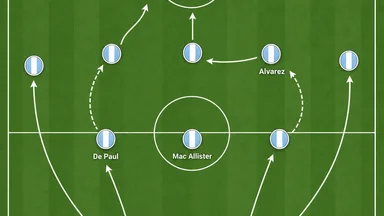
Argentina's 2022 World Cup-winning squad carried three specialist full-backs (Nahuel Molina, Gonzalo Montiel, and Marcos Acuña) and two dedicated holding midfielders (Rodrigo De Paul and Leandro Paredes). Only two players—Angel Di Maria (right wing and left wing) and Paulo Dybala (forward and attacking midfield)—could be considered multi-positional in the sense of covering distinct roles. France's runner-up squad had a similar profile: four centre-backs, three left-backs (including Lucas Hernandez, who also played centre-back), and two dedicated defensive midfielders. Only two players covered four or more positions: Adrien Rabiot (central midfield, defensive midfield, and left midfield) and Kingsley Coman (both wings and forward).
Both squads succeeded with a relatively low number of versatile players. But the 2026 context may demand more. With an extra match and a round of 32, the physical load increases. Argentina's 2022 run included a group-stage loss to Saudi Arabia, which forced them to play at maximum intensity in the remaining group matches. In 2026, a similar stumble could require three high-intensity matches in quick succession, increasing the need for rotation.
Some analysts argue that the 2022 champions won because of specialist quality, not versatility. Lionel Messi's unique role as a free-roaming forward, for example, cannot be replicated by a utility player. But the squad's depth was tested: Argentina used 21 outfield players across seven matches, and several substitutes played crucial roles. The 2026 winners may need four or five players who can cover three or more positions, simply to manage minutes across seven matches.
France's 2022 squad also showed the risks of specialist-heavy construction. When Lucas Hernandez was injured early, his brother Theo Hernandez took over at left-back, but the team lacked a natural replacement for the left-sided centre-back role that Lucas could also fill. A versatile alternative might have allowed France to adjust without compromising defensive structure. In 2026, such gaps could prove fatal in the round of 32.
The Decline of the One-Role Backup Goalkeeper
The third goalkeeper slot has long been a symbolic selection, a player who almost never plays unless both keepers ahead are injured. In 23-man squads, the third goalkeeper occupied a spot that could have gone to an outfield player. With 26-man squads, teams can now carry four goalkeepers if they wish, but the opportunity cost of that fourth spot is even higher: it could be a versatile outfield player who contributes in multiple matches.
Some national teams are already reconsidering the traditional three-keeper policy. Brazil, for example, has experimented with taking only two goalkeepers to recent tournaments, using the extra slot for a utility defender. In 2026, the trend may accelerate. If a team's first-choice goalkeeper is durable and the second-choice is reliable, carrying a third goalkeeper becomes a luxury that reduces squad flexibility. The round of 32 adds urgency: an injury to a goalkeeper in the group stage could be managed with a short-term replacement from the standby list, which FIFA allows for medical reasons.
Outfield versatility trumps insurance at the third goalkeeper spot. A player who can cover two or three positions provides more value over seven matches than a goalkeeper who will likely never take the field. That said, the risk calculus varies. Teams with injury-prone goalkeepers or those playing in extreme heat (where dehydration and muscle cramps are more common) may still prefer a third specialist. But the general trend points toward reducing goalkeeper numbers to free up slots for multi-role outfield players.
Germany's head coach Julian Nagelsmann has publicly suggested that 26-man squads make the third goalkeeper redundant. While no federation has officially announced a two-keeper policy for 2026, early scouting reports from Germany and Brazil indicate that they are identifying versatile outfield players as potential squad members, rather than a fourth goalkeeper.
Positional Flexibility Metrics from Club Football
Club football has already embraced positional versatility as a measurable attribute. Opta, the data provider, defines a "versatility index" that tracks how many distinct positions a player has played in competitive matches over a season. According to Opta data from the 2024-25 Premier League season, roughly 17% of outfield players appeared in three or more positional roles. That figure has risen from around 12% five years earlier, reflecting tactical trends toward fluid formations and multi-functional players.
Bayern Munich's Joshua Kimmich exemplifies the modern versatile player. He has started matches at right-back, central midfield, and centre-back for club and country. His ability to switch roles mid-match without a drop in performance allows his manager to adapt tactics without substitutions. Similarly, Manchester City's John Stones has evolved from a pure centre-back to a hybrid defender who steps into defensive midfield during possession phases. These examples show that top clubs value versatility enough to develop it in their players.
National teams are now applying similar metrics to their scouting. The German Football Association (DFB) has incorporated positional range into its youth development criteria. A 2024 scouting report flagged 14 young German players who had played at least three positions at club level, marking them as potential 2026 squad candidates. The Brazilian Football Confederation (CBF) now tracks "positional range" data for its senior and U-23 players, using it to inform squad selection.
Not everyone agrees that versatility is a net positive. Some coaches argue that specialized players offer higher peak performance in specific roles. A player who splits training time across multiple positions may never master any single one. But the tournament structure of 2026 may force a trade-off: a slightly lower peak in one role versus the ability to cover multiple roles across seven matches. For many teams, the latter will win out.
How Scouting Departments Are Adjusting Recruiting Criteria
National team technical directors are revising their scouting profiles to prioritize versatility. England's Football Association, for example, has asked its U-21 scouts to flag players who have played at least two positions at senior club level. The same applies to senior team scouts monitoring Premier League and Championship players. The goal is to build a pool of candidates who can fill multiple roles, reducing the risk of squad gaps due to injury or form.
Smaller nations stand to benefit most from this shift. Teams with less depth traditionally struggled to cover every position with specialist backups. Versatile players allow them to field competitive lineups even when first-choice players are unavailable. Iceland's Euro 2016 run is a case in point: Birkir Bjarnason played five different positions during the tournament, including left midfield, central midfield, and forward. His flexibility allowed Iceland to adapt to opponents without sacrificing quality.
Germany's 2024 scouting report, mentioned earlier, identified 14 versatile youth players, including several who can play both full-back and winger or both defensive midfield and centre-back. The DFB's technical staff believe that such players will be crucial for navigating the 2026 schedule. Similarly, the Brazilian federation has started using positional range as a key performance indicator in its data analysis, weighting it more heavily than in previous cycles.
Some federations are also experimenting with hybrid training regimens. The French Football Federation has encouraged its youth academies to rotate players through multiple positions during development, rather than specializing early. This approach mirrors club academies like Barcelona's La Masia, which has historically produced multi-positional players like Sergio Busquets (defensive midfield and centre-back) and Jordi Alba (left-back and left wing). The 2026 World Cup may accelerate this trend globally.
Based on the structural and tactical analysis, managers building 2026 squads should carry at least four players who can play three or more positions. These utility players will be essential for managing minutes across seven matches and adapting to in-game situations. Avoid dedicating squad slots to set-piece specialists only; while a dead-ball expert can win a match, the risk of carrying a one-role player outweighs the reward in a 26-man squad. Prioritize midfielders who can drop to full-back, as the full-back position is physically demanding and having a midfielder who can cover that role allows rotation without sacrificing quality. Select forwards who can also play as a No.10 or on the wing, creating unpredictability for opponents. Finally, use pre-tournament friendlies to test hybrid roles, assessing a player's adaptability before the knockout stages. These recommendations are not without trade-offs; some managers may prefer to stick with specialists and rely on a smaller rotation. But the expanded tournament structure and substitution rules create a strong incentive to prioritize versatility. The teams that adapt their squad-building philosophy will have a competitive advantage in the round of 32 and beyond.