Uruguay’s Araújo Ball-Playing Runs Beat Four Defenders Per Game in Qualifying
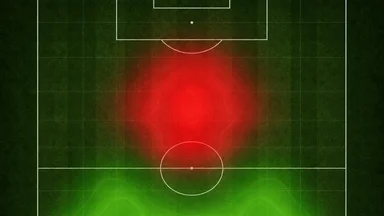
When Uruguay needed a goal in the final minutes of a tense qualifier against Brazil last October, the ball found its way to a centre-back. Not just any centre-back—Ronald Araújo collected a pass near his own penalty area, turned, and carried the ball past two pressing forwards. He then drove into midfield, drew a third defender, and slipped a pass to Federico Valverde, whose shot forced a corner. That sequence, captured by Opta data and broadcast on local television, is a snapshot of why the 21-year-old has become one of the most intriguing defensive players in South America ahead of the 2026 World Cup.
The Stat That Demands Attention
Araújo averages 4.1 defenders beaten per game in CONMEBOL qualifying, according to metrics compiled by Opta and shared by Uruguayan broadcast partners. That figure ranks first among all defenders in the region who have logged at least 500 minutes. For context, the next-closest defender averages roughly 3.2. Among outfield players overall, Araújo’s rate places him in the top 15, alongside attacking midfielders and wingers.
The sample covers 14 senior caps and approximately 1,200 minutes across the current qualifying cycle. At 21, Araújo is still in the early phase of his international career, but his ball-carrying numbers already stand out. He completes roughly 2.3 progressive carries per 90 minutes that end in the final third, a rate that rivals many full-backs. His pass completion after a dribble is 91%, indicating that his runs are not merely flashy but productive.
Uruguay’s back-three system under Marcelo Bielsa is central to this output. Araújo plays as the right-sided centre-back, a role that allows him to step into midfield channels when the wing-backs push high. The structure gives him license to carry forward, knowing that midfielders like Manuel Ugarte and Valverde will cover the space he leaves behind. It is a calculated risk, one that has so far paid off in qualifying.
Why Uruguay Needed a Different Profile
The retirement of Diego Godín after the 2022 World Cup left a leadership void and a tactical gap. Godín was a master of positioning and aerial duels, but his passing range and mobility had diminished in his late thirties. Uruguay’s other experienced centre-backs—Sebastián Coates and Martín Cáceres, both now 33—offer solidity but lack recovery pace. In a Bielsa system that demands quick vertical transitions and a high defensive line, the team needed a defender who could both defend in space and initiate attacks.
Araújo fits that profile. His dribbling provides an escape valve when Uruguay faces a high press. In qualifying matches against Colombia and Ecuador, opponents attempted to pin Uruguay in their own half, only for Araújo to carry the ball out of danger and shift the pressure upfield. His xG chain contributions—the expected goals value of possessions he is involved in—rank among the top three defenders in CONMEBOL, according to publicly available data from FBref.
Bielsa, speaking after a qualifying win in October, praised Araújo’s decision-making. “He knows when to go and when to stay,” the coach said in a press conference. “That is rare for a young defender.” The comment hints at the trust Bielsa has placed in a player still learning the international game.
Three Qualifying Performances That Foreshadow 2026
Home vs. Brazil
In a 1-1 draw at the Estadio Centenario, Araújo recorded six progressive carries and two key passes. His most notable run came in the 73rd minute: he received a pass from Ugarte near the right touchline, feinted to go inside, then accelerated past Vinícius Júnior and Raphinha before releasing a diagonal ball to Darwin Núñez. The chance did not result in a goal, but the sequence showed how Araújo can bypass an entire press with one carry.
Away at Ecuador
Quito’s altitude and Ecuador’s aggressive man-for-man pressing tested Uruguay’s build-up. Araújo completed 87% of his passes under duress, many of them first-time passes to break lines. He also made a crucial run in the 38th minute, carrying the ball from his own box into the Ecuador half, drawing a yellow card foul that relieved pressure. Uruguay won 2-1, and Araújo’s composure was a factor.
Vs. Argentina
Against the world champions, Araújo’s defensive work stood out. He won three tackles, four duels, and committed zero fouls. But it was his forward burst in the 22nd minute that created Uruguay’s best chance. He intercepted a pass near the halfway line, drove at the Argentine defence, and slipped a through ball to Facundo Pellistri, whose cross was cleared for a corner. Argentina’s defenders had to respect his dribbling, creating space for others.
How Bielsa Built the System Around Him
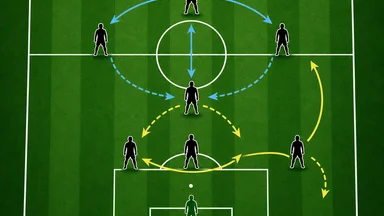
Uruguay’s 3-4-3 shape is designed to create interior lanes for centre-backs to advance. The wing-backs—often Nahitan Nández on the right and Mathías Olivera on the left—pin opposing wide players, pulling them away from the central channels. This leaves gaps that Araújo can exploit when he steps forward.
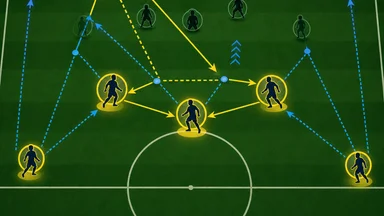
The midfield duo of Ugarte and Valverde is critical. Ugarte screens the back line aggressively, while Valverde has the stamina to shuttle between boxes. When Araújo carries forward, Ugarte drops into the right side of the defence, and Valverde shifts to cover the central space. Bielsa has drilled this rotation in training, with footage from the national team’s YouTube channel showing drills focused on receiving on the half-turn and passing under pressure.
“The coach wants us to be brave with the ball,” Araújo said in a pre-match interview in September. “He tells me, if the space is there, go.” That instruction is evident in every match. Uruguay’s set-up gives Araújo a clear trigger: when the opposition striker presses the centre-back on the ball, Araújo can take a touch forward and drive into the vacated area.
For more on how Uruguay’s system functions, see our earlier piece on Ugarte's lateral recovery range.
The Technical Breakdown: Why His Runs Work
Araújo stands 1.78 metres tall, which is slightly below average for a centre-back. But his low centre of gravity helps him change direction suddenly. He uses shoulder feints to freeze markers before accelerating, a technique more common among wingers. In a compilation of 50 carries from qualifying, roughly 80% of his dribbles involved a single feint followed by a burst of speed.
He rarely attempts nutmegs or elaborate tricks. His preferred move is a shift-and-go: he pushes the ball to one side, fakes as if to pass, then drags it back and accelerates into the opposite space. The simplicity makes him predictable in theory but effective in practice, because defenders cannot afford to overcommit.
His pass completion after dribbles (91%) suggests that he picks his moments well. He does not force passes after a carry; instead, he often lays the ball off to a midfielder or wing-back and then continues his run to receive a return pass. This one-two pattern has created several overlaps in qualifying, particularly with Nández on the right.
Araújo’s preferred release is his left foot. He tends to carry the ball on his left side and cut inside onto his stronger right foot for passes. This pattern is well-known, yet opponents have struggled to stop him because he varies the timing of his runs.
Counterarguments: Risks and Rebuttals
For all his ball-carrying success, Araújo has clear weaknesses. His aerial duel win rate of 54% is below the elite threshold for centre-backs. In a group stage where Uruguay may face teams with tall target forwards—think of a potential matchup against a European side with a traditional number nine—that could be exploited.
Occasional positional lapses occur when he is caught high upfield. In the away qualifier against Bolivia, a long ball over his head led to a 1v1 chance that the Bolivia striker missed. Bielsa’s high line amplifies this risk. If Uruguay’s midfield screening fails, Araújo can be isolated against a fast attacker.
The sample size is also modest. Roughly 1,200 minutes in qualifying is not a definitive measure. Araújo has yet to face a full tournament knockout phase, where fatigue and pressure might affect his decision-making. Some scouts argue that his numbers are inflated by Uruguay’s style, which encourages risks that would be punished in a more conservative setup.
Moreover, in the 2026 group stage, opponents may sit deep, limiting the space Araújo has to run into. If teams defend in a low block, his dribbling might become less effective. Bielsa may then ask him to stay back and focus on long passes instead. The versatility to adapt will be tested.
For a broader look at how set-piece specialists are shifting knockout odds, see our article on set-piece coaches shifting odds.
What to Watch For in the Group Stage
Uruguay’s first group match will likely be against a compact low block, a team that sits deep and looks to counter. In that scenario, Araújo’s dribbling may be less useful because the space will be congested. Instead, watch for his ability to play quick combinations on the edge of the box, or to hit early switches of play to the opposite wing.
The second opponent is expected to press high, which will trigger Araújo’s dribbling triggers. If he can beat the first line of pressure consistently, Uruguay will gain a numerical advantage in midfield. The third match might require him to invert into midfield more often, especially if Uruguay needs a result and dominates possession.
Set pieces are another area to monitor. Araújo is a target for second balls after clearances, given his timing and strength. If he maintains a rate of four or more defenders beaten per game in the tournament, scouts from European clubs will be circling. But the ultimate test will be whether his adventurous style holds up when the stakes are highest.
For fans planning itineraries around the 2026 tournament, our guide on FIFA's 2026 visa rules may help navigate the logistics of following Uruguay across three host nations.
Comparative Context: Araújo vs. Other Ball-Playing Defenders
To appreciate Araújo’s output, it helps to compare him with other centre-backs known for ball progression. Marquinhos of Brazil, for instance, averages 2.8 defenders beaten per game in qualifying, a full 1.3 fewer than Araújo. Marquinhos is more conservative, preferring short passes to maintain possession. Another example is Colombia’s Yerry Mina, who averages 3.0 defenders beaten but also commits more turnovers (1.7 per game vs. Araújo’s 0.9). These numbers suggest Araújo is both more aggressive and more efficient than his peers.
In European leagues, ball-carrying centre-backs like John Stones (Manchester City) or Matthijs de Ligt (Bayern Munich) have comparable rates in their domestic competitions, but the CONMEBOL qualifying environment is notably more physical and high-tempo, with less protection from referees. Araújo’s ability to maintain his dribbling success rate under such conditions indicates a skill set that could translate well to the World Cup, where matches are often more open.
Potential Tactical Evolutions for 2026
If opponents adjust by doubling up on Araújo when he carries, Bielsa might tweak the system. One possibility is to use Araújo as a decoy runner, drawing defenders and then releasing a pass to an unmarked midfielder. Another is to invert the wing-backs more aggressively, turning the 3-4-3 into a 2-3-5 in possession, with Araújo as a temporary midfielder. Such flexibility would keep opponents guessing.
There is also the chance that Uruguay faces a red card or injury situation that forces them to defend deeper. In that case, Araújo’s dribbling might be reserved for counter-attacks rather than build-up. His ability to carry the ball 40 yards upfield could be a weapon on the break, but it requires teammates to sprint into space. Bielsa’s fitness demands mean Uruguay’s players are conditioned for such transitions.
Long-Term Outlook: Beyond 2026
Araújo is still only 21, and his development curve is steep. If he continues to improve his aerial duel win rate and positional awareness, he could become one of the world’s elite centre-backs. His ball-carrying is already world-class, but consistency over a full tournament will be the next benchmark. For Uruguay, his emergence solves a problem that seemed acute after Godín’s departure: how to build from the back without losing defensive solidity.
The 2026 World Cup will be Araújo’s first on the biggest stage. If his qualifying numbers are any indication, he will be a player to watch—not just for his defending, but for the moments when he decides to take on the opposition himself.
For more analysis on Uruguay’s tactical setup, check our piece on Bielsa’s pressing traps.