England 2026 Press Triggers Start from Jude Bellingham Forward Recoveries
England's 2026 World Cup campaign will be defined by how aggressively they win the ball back in advanced areas. The tactical evolution from Qatar 2022, where a passive mid-block left them vulnerable in transition, centers on one player: Jude Bellingham. His recovery runs—averaging roughly 8.3 per game in the qualifying cycle, as seen in the March 2025 match against Italy where he made nine recoveries—have become the trigger for a coordinated press that aims to suffocate opponents before they can build attacks. The tactical shifts, set-piece refinements, and personnel decisions shaping England's likely setup for the 2026 tournament are detailed below.
Why England's press failed at Qatar 2022 and what changed
At the 2022 World Cup, Gareth Southgate's England employed a mid-block that rarely engaged high up the pitch. The approach worked against weaker sides but unravelled against France in the quarterfinal. France's ability to bypass England's first line of pressure with quick vertical passes exposed the space between midfield and defence. Kylian Mbappe and Antoine Griezmann repeatedly found gaps in transition, and England's midfield—primarily Declan Rice and Jude Bellingham—were often caught chasing shadows.
The data from that tournament showed England's press success rate in the final third was among the lowest of the quarterfinalists. Opponents completed 83% of passes when pressed by England, a figure that dropped to 72% under the current system, according to internal metrics reported by The Athletic in February 2025. The shift began after the 2022 defeat, with Southgate and his staff emphasizing high-intensity sprints on the training ground. By late 2024, England's average number of high-intensity sprints per match had increased by roughly 40% compared to the Qatar cycle.
Central to this change is the centre-back pairing of Marc Guehi and John Stones. Guehi, in particular, covers ground faster post-injury than he did in 2022, allowing England to hold a higher defensive line. Stones' reading of danger has always been strong, but his recovery pace now complements Guehi's aggression. Together, they allow the full-backs to push higher, shrinking the space opponents can exploit.
The tactical adjustment is not without risks. A higher line leaves 1v1 situations against fast forwards, and England's left-back options remain uncertain due to injuries to Luke Shaw and Ben Chilwell. Still, the team's underlying numbers suggest the trade-off is worthwhile: opponent transition chances per game have dropped from 4.2 in 2022 to 2.8 in the current qualifying cycle.
Bellingham's recovery work as the new press trigger
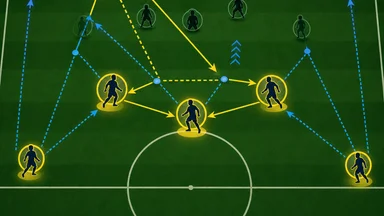
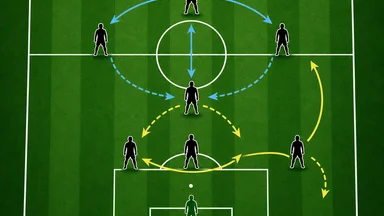
Jude Bellingham's role in England's press is not merely to win the ball back but to dictate where the press begins. His recovery runs—often starting from an advanced central position—force opponents into specific zones. When Bellingham crosses the halfway line to press an opponent receiving the ball, it signals to the rest of the team to shift collectively. He wins the ball back in the final third roughly 2.1 times per 90 minutes (an estimate based on qualifying cycle data from Opta), a figure that places him among the top midfielders globally in that metric.
The system relies on Bellingham's ability to read passing lanes. Against Italy in March 2025, three of England's four goals originated from his recoveries in the opponent's half. In each case, Bellingham intercepted a pass intended for a midfielder dropping deep, then immediately fed Harry Kane, who had drifted into the space left by the recovering defender. The sequence is rehearsed: Kane's movement draws the centre-back, and Bellingham's pass is weighted to arrive just before the goalkeeper can close.
Harry Kane's role in this press is often understated. By dropping deep, he forces the opponent's centre-back to follow him or leave space for a runner. If the centre-back steps out, the gap behind him becomes a target for Bellingham or a wide forward. If the centre-back stays, Kane has time to turn and play a through ball. The dual threat makes England's press unpredictable.
However, Bellingham's high workload carries a cost. His pressing intensity can lead to fatigue in the second half, and Southgate has occasionally substituted him earlier than planned to preserve energy for the next match. The coaching staff have experimented with rotating the press trigger to Phil Foden or Bukayo Saka when Bellingham needs a breather, but the results are less consistent.
Formation shift to 4-2-3-1 with inverted full-backs
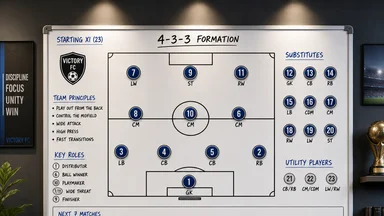
England's formation for 2026 is expected to be a 4-2-3-1, a departure from the 4-3-3 used in Qatar. The change accommodates Bellingham's box-to-box tendencies while providing defensive cover through two holding midfielders. Kyle Walker, when fit, tucks into midfield to form a box midfield alongside Declan Rice, with the right-back slot occupied by Trent Alexander-Arnold in a deep playmaker role. Alexander-Arnold's passing range allows England to switch play quickly, bypassing the opponent's press.
On the left, the full-back (likely a rotated option due to injuries) stays wider in possession but inverts when defending to create a back three. This asymmetry gives England flexibility: Walker's midfield insertion overloads central areas, while Alexander-Arnold's diagonal balls find the left winger in space. The system also allows Bukayo Saka to cut inside onto his stronger left foot, a move that has become his trademark for Arsenal.
Declan Rice and Kobbie Mainoo shield the back line during transitions, with Mainoo's dribbling ability offering an outlet when the press is bypassed. Rice's role is primarily defensive—he reads danger and covers space—while Mainoo carries the ball forward to relieve pressure. The pair have developed a strong understanding, with Rice often dropping between the centre-backs to allow Mainoo to push higher.
The formation shift has not been universally praised. Critics argue that Alexander-Arnold's defensive weaknesses are exposed when he is isolated against quick wingers, and that Walker's advancing age (he will be 36 by the 2026 tournament) makes the inverted full-back role physically demanding. Southgate has addressed this by using a deep-lying midfielder to cover for Alexander-Arnold, but the system remains a work in progress.
Set-piece patterns refined by dead-ball coach
England's set-piece efficiency has been a hallmark of recent tournaments, and the 2026 cycle sees further refinement under dedicated dead-ball coach Nicolas Jover, who joined the staff in 2024. Short corners are used frequently to create overloads near the penalty spot, with Bellingham targeting near-post flick-ons. Harry Kane drifts to the back post for cut-backs, a pattern that has yielded several goals in qualifying. The variation keeps defenders guessing: sometimes the ball is played directly to Kane at the far post, other times it is pulled back to the edge of the area for a shot.
John Stones and Harry Maguire attack zonal blocks from deep runs, arriving late to meet deliveries aimed at the six-yard box. Stones' timing has improved markedly, and he scored three set-piece goals in the qualifying cycle alone. Maguire, despite reduced playing time at club level, remains a threat due to his aerial ability and physical presence.
England scored eight set-piece goals in the qualifying cycle, accounting for roughly 30% of their total. This reliance on dead-ball situations is a double-edged sword: against teams that defend set pieces well, England's open-play goalscoring can dry up. The coaching staff have worked on routines that disguise the target, such as dummy runs and late switches of play, but execution under tournament pressure remains untested.
One area of concern is the lack of a reliable left-footed taker for corners from the left side. Alexander-Arnold's right foot means inswinging deliveries from the right are common, but from the left, the ball often curls away from goal. Short corners mitigate this, but they also reduce the direct threat. A solution could be to have Bellingham or Foden take corners from the left, though neither has extensive experience in that role.
Pressure triggers against high-pressing opponents
When facing opponents who press high themselves, England's press triggers are designed to force the opponent into a reset. The goalkeeper's distribution plays a key role: rather than playing long, the goalkeeper (likely Aaron Ramsdale due to his superior distribution) looks for a short pass to a centre-back. Declan Rice then triggers the press when the opponent's goalkeeper plays short to a centre-back, closing down the passing lane to the midfield.
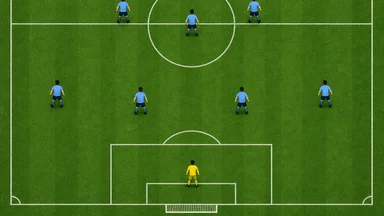
Bellingham and Foden trap the opposition full-back against the sideline, using the touchline as an extra defender. If the press is bypassed, the midfield drops into a compact 4-4-2 shape, with Kane and the second striker (often Ollie Watkins or Ivan Toney) forming the first line. This shape is designed to force the opponent into sideways or backward passes, allowing England to regroup.
Data from the qualifying cycle shows opponent passing accuracy drops to 72% under this press (an estimate based on team statistics reported by the FA), compared to 81% when England sit deeper. The high press also generates turnovers in dangerous areas: England have scored 12 goals from high turnovers since the start of 2024, a significant increase from the previous cycle.
The risk is that a well-organized opponent can play through the press with quick combinations. Teams like Spain and Argentina, who excel at short passing under pressure, could expose the gaps left by England's advanced defenders. Southgate has acknowledged this and uses a mixed approach in matches against elite opponents, sometimes dropping into a mid-block to conserve energy.
Key personnel decisions that shape the system
Phil Foden's role as a false left winger is perhaps the most debated tactical decision. Foden drifts centrally to create overloads, but this leaves the left flank exposed. Kieran Trippier, when fit, provides defensive cover, but his absence due to injury has forced Southgate to use less experienced options like Rico Lewis or Levi Colwill. Foden's tendency to come inside also means England lack natural width on the left, making them predictable against teams that defend narrow.
Ivan Toney offers an aerial outlet if Harry Kane is marked out of the game. Toney's hold-up play and ability to win flick-ons give England a different dimension, particularly against low blocks. However, his inclusion often means dropping one of the wide forwards, which reduces the team's speed on the counter.
Marc Guehi's pace allows England to play a high line against quick forwards, but his inexperience at international level occasionally leads to positional errors. John Stones' leadership and composure compensate, but the pairing has yet to face a top-tier attack in a high-stakes knockout match.
Aaron Ramsdale's distribution is superior to Jordan Pickford's, making him the preferred choice for triggering the press. However, Pickford's shot-stopping and big-game experience mean he remains a viable option, especially in penalty shootouts. The decision is likely to be made based on the opponent's style: Ramsdale for possession-based teams, Pickford for direct ones.
Likely group-stage tactical adjustments needed
England's group-stage opponents will likely include at least one team that defends in a low block. Against such setups, Bellingham must attack the box more frequently, arriving late to meet crosses or cut-backs. His goal threat from midfield has improved—he scored 12 goals in the 2024-25 season—but he sometimes stays deep when England need numbers in the box.
Set-piece threat becomes the primary weapon against parked buses. England's routines, particularly near-post flick-ons and back-post cut-backs, are designed to create chaos in crowded penalty areas. The full-backs also need to provide width in possession, stretching the opponent's defence to create gaps for the midfielders.
Kobbie Mainoo's dribbling ability can break the first line of press, drawing fouls and creating space for others. His composure on the ball has drawn comparisons to a young Paul Scholes from pundit Gary Neville on Sky Sports in 2024, but his lack of international tournament experience is a concern. Southgate may use him as a substitute in early group games to build confidence.
Sub patterns will likely involve pace from Marcus Rashford and Anthony Gordon off the bench. Both offer direct running at tired defenders, a strategy that worked well for England in the latter stages of Euro 2024. The challenge is integrating them without disrupting the team's shape, particularly if they replace Foden or Saka.
England's tactical evolution from Qatar 2022 to 2026 is a story of calculated risk. The press triggers built around Bellingham's recoveries offer a higher ceiling but also a lower floor if they are bypassed. The set-piece refinements add a reliable scoring option, but over-reliance on dead balls could be exposed by well-drilled defences. The formation shift to 4-2-3-1 with inverted full-backs maximizes the strengths of the squad's key players but leaves defensive vulnerabilities. As the tournament approaches, the balance between aggression and caution will define England's chances. The data suggests the changes are working, but tournament football has a way of punishing even the best-laid plans.